Carnivorous Marsupials of Australia
Quolls, Wambengers & Dibblers: A Case Study
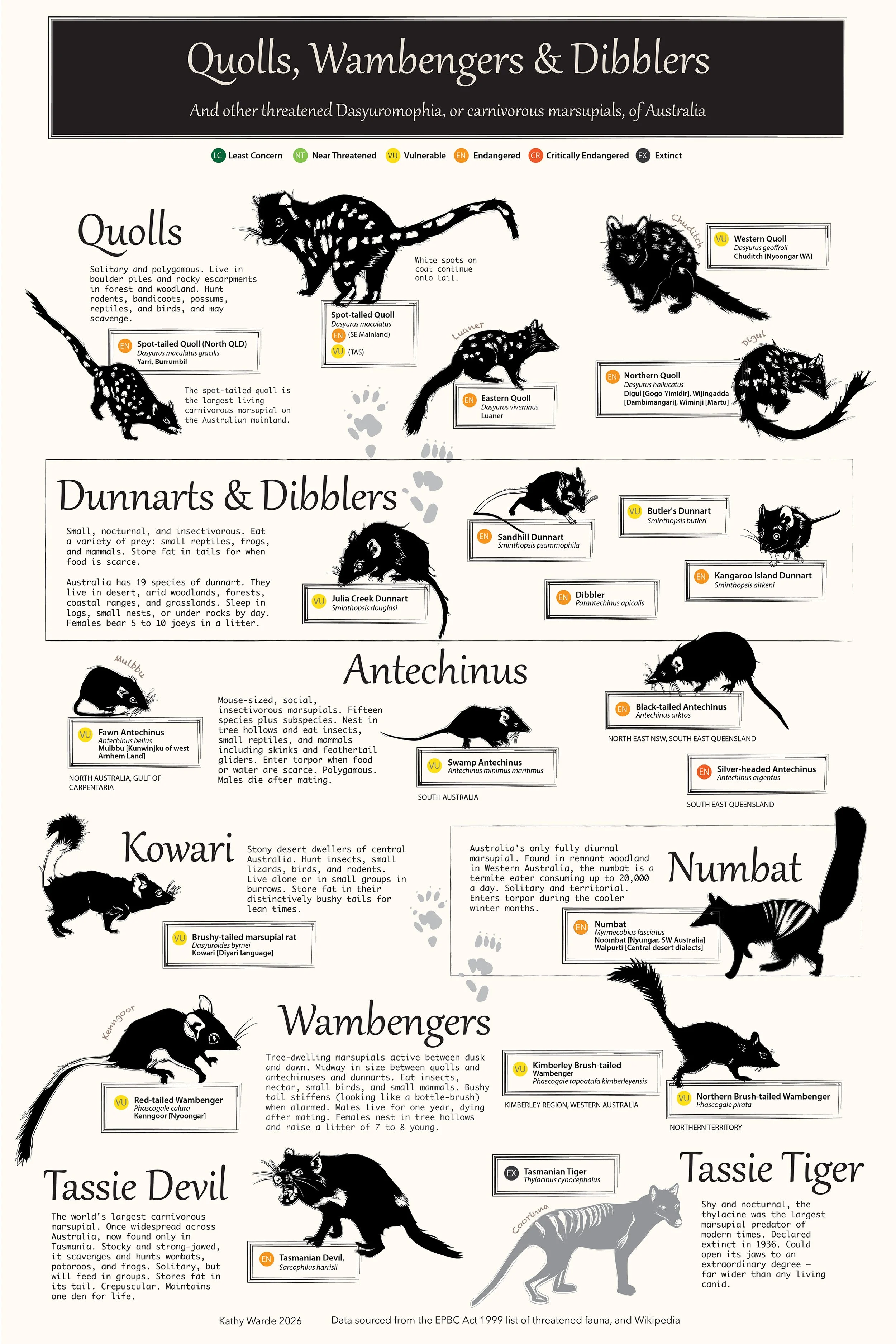
Problem
Australia’s mammal fauna is unusual, and its small carnivorous marsupials are a big part of that story.
Known as the dasyuromorphs, quolls, antechinus, dunnarts, wambengers and their relatives, carnivorous marsupials range from mouse-sized insect hunters to the Tasmanian devil. Yet despite making up roughly a quarter of Australia’s mammals, the group is often overshadowed by more familiar species such as kangaroos, koalas, and wombats.
Many of these species are also in decline due to habitat loss, introduced predators, and changing fire regimes.
While species and conservation data are publicly available through EPBC Act listings, the Atlas of Living Australia, and related datasets, it is typically presented as individual records or tabular lists. This makes it difficult to view the group in context, compare species at a glance, or understand their diversity and conservation status as a whole.
In brief
Before: Species listed individually across datasets and profiles
After: A single visual field guide for comparison and exploration
Approach
This project translates species and conservation data (primarily from EPBC Act listings) into a visual format for easier access and comparison.
Rather than following strict taxonomy, the layout uses visual grouping to support scanning, comparison, and pattern recognition. Each animal is illustrated using a simple black silhouette style. This creates a consistent visual language (for related infographics projects too).
The design uses bold silhouettes with minimal detail, loose clustering to guide reading, colour-coded conservation status, and a vertical layout for mobile viewing.
Process
Extracted threatened fauna data from EPBC Act listings
Structured and analysed the dataset in Excel to identify patterns and groupings
Developed a visual system in Adobe Illustrator, including reusable silhouette assets for consistency
Iterated layout and hierarchy to support scanning and comparison across species
Outcome
The result is a field guide-style infographic that brings together Australia’s carnivorous marsupials in a single, cohesive view. More broadly, the project is a small attempt to make that diversity more visible and accessible, exploring ways to communicate scientific information more effectively through visual design.
Related infographics
This piece forms part of an ongoing series exploring Australia’s threatened animals:
Sources
Environment Protection and Biodiversity Conservation Act 1999 (EPBC Act) List of Threatened Fauna, https://www.dcceew.gov.au/environment/epbc, accessed 7 April 2026.